
|
|
Second Law
|
|
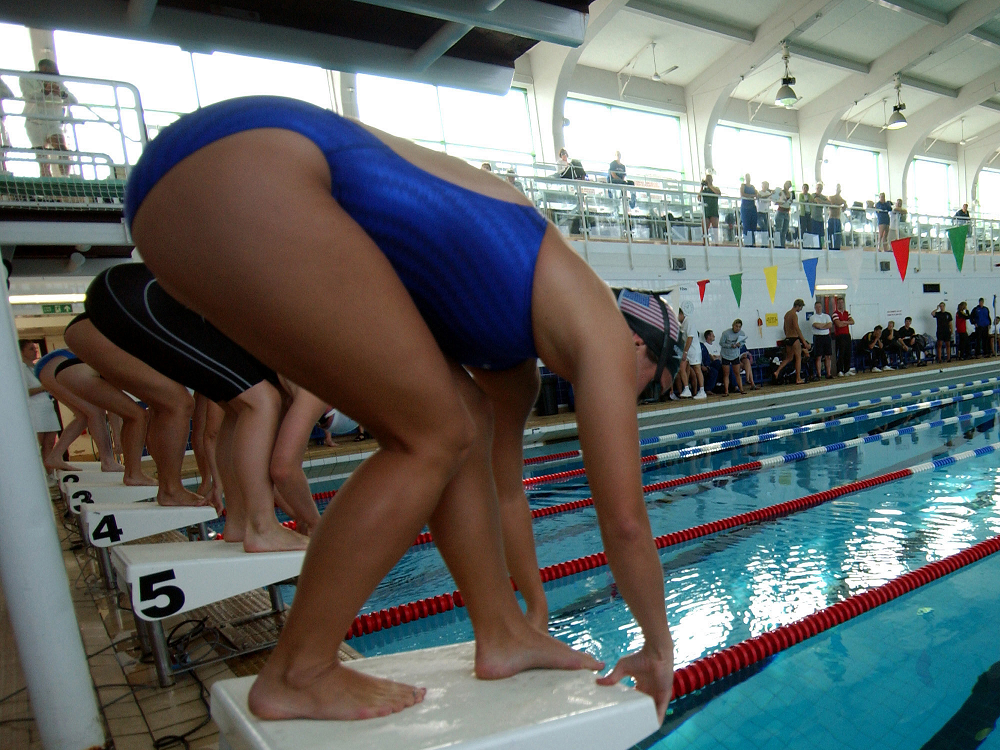
Newton's First Law of Motion States that: An object at rest stays at rest and an object in motion stays in motion with the same speed and in the same direction unless acted upon by an unbalanced force. Even though that may seem like a lot, it is actually really simple. You can compare it to diving off a swim block at a swim meet. The first part of the law: An object at rest stays at rest, relates to when you are on the block, ready to spring forward, but not moving yet. The second part of the law: an object in motion stays in motion with the same speed and in the same direction, relates to when you spring off the block and you are in the air. |
||
On the block: |
In the air: |
|
|

|
|
|
The first law says that when you aren't moving, you will stay not moving. That means that if you are on the block and you aren't moving yet, you won’t suddenly fly up of backwards. |
The first law says that when you are moving, you will keep moving the same way, meaning that you won't change direction or speed. That means that when you are diving, you won't suddenly go backwards or stop moving and float in the air. |
|
|
Unless acted upon by an unbalanced force. |
Unless acted upon by an unbalanced force. |
|
|
What unbalanced force? An unbalanced force is a force that is applied on the object in question. When an unbalanced force is applied on an object, Newton's First Law doesn't work anymore. |
What unbalanced force? An unbalanced force is a force that is applied on the object in question. When an unbalanced force is applied on an object, Newton's First Law doesn't work anymore. |
|
|
Example: If your friend pushes you off your block, you won't stay not moving, you will fly off the block. |
Example: If someone in the water tackles you into the water, you won't keep going forward at the same speed, you will drop straight down. |
|
